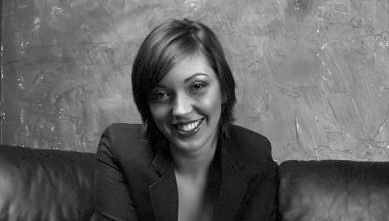
I wrote this proposal in January 2009; it focuses on Life Line's relationship to the Jungian approach to healing, the body and scars. It was accepted. I got strep throat the day before the conference, but if it fits with the conference theme, I will re-submit for next year.
Proposal:
Life Lines: The Scar as Site of Transformation is a multimedia photography and audio exhibition that explores the relationship of psyche and soma. Since 2006 I have interviewed and photographed over 50 people willing to expose their scars and tell their stories of wounding and healing. In this installation, I will present photographs and audio-recordings of five participants whose narratives demonstrate the integration and transformation of physical disfigurement. I will introduce this exhibit with a talk on the subject and its implications for Jungian psychology.
This project finds its roots in my practices as a psychotherapist and a visual artist, as well as my study at the University of Toronto’s Paradigms and Archetypes programme. I believe that while we may find our scars unsightly and shameful, they can be re-narrated as evidence of growth and transformation. Jungian interpretation provides rich ground for the exploration of these issues.
We can look to the analysis of fairytales for a template upon which to reconstruct our stories of wounding. Just as a life-saving surgery will transform both body and mind, fairytale transformation is symbolic of the psyche and demonstrated by change in the body. In fairytales, however, the act of cutting or severing is commonly understood as a differentiation of the unknown, a first step toward individuation.
To some thinkers, the body represents this unknown, or unconscious; it is opposed to the outside world in which conscious actions take place. Erich Neumann posits that the skin and orifices form the locales for exchange between these two realms and thus are tinged with the numinous. Jungian analyst and dermatologist Anne Maguire echoes this reading, seeing a rupture of the skin is a breakdown of order, the wound a place over which chaos reigns.
One way to gain comfort with this chaos is through the telling of stories – personal fairytales. Like cultural fairytales, the usefulness of these stories does not depend on their factual veracity. Some of the most positive scar stories do not conform to an external understanding of reality. For example, one woman believed herself to be the survivor of an almost fatal industrial accident for the greater part of her childhood. Only as an adolescent did she realize that this story was impossible, given the small scar it detailed. This fairytale, however, had given her strength and faith in her survival abilities through several childhood diseases.
I wish to exhibit these photographs and narratives in an attempt to spark dialogue and personal reflection on the part of conference participants. Discovering our personal fairytales brings us closer to understanding and meaning. In our collective healing process, we must gain comfort with the unknown, which includes our bodies and their numerous, numinous imperfections.
Tuesday, November 17, 2009

ACM Creativity and Cognition 2009 Conference Proposal -- Scar Story-telling/Photographing as a Daily Creative Process
This is a proposal I didn't send in, because I didn't know how to make something a pdf and I'd left it to the last minute (literally). I went to a 1950's dance night and felt guilty, instead.
Abstract:
The body is created on a daily basis through the unification of physical experience. The Life Lines project examines images and stories of scar acquisition and meaning as methods of creative re-unification after injury.
Presentation Proposal:
As the boundary between the inside (body) and the outside (world), the skin plays an important role in the creation of identity [1]. Paint, burns, inscriptions and areas of exposure all convey information about ourselves and our bodies. Scars are often ambiguous markers – even on the same body, scars can be seen as both signs of weakness and signs of strength. In Life Lines, a social intervention and art project, participants have described their scars as markers of poverty, healing, strength, change, stupidity, emasculation and adventure [11]. Just as artists will make an infinite number of unique paintings from the same paint set, we all create unique and developing images and narratives about our scars.
Life Lines is composed of an online platform containing photographs, text and areas for user comments; it is also displayed in gallery exhibitions [11]. Since 2006, I have photographed over fifty participants for this project. In addition, I ask for written narratives describing how participants got their scars, what their scars mean to them, and what they mean to other people. Because it is publicly available online, individuals from around the world have contacted me with their own photographs, which are published on the same site.
Foucault proposed the body as the meeting point of society and personal power [3]. Similarly, Sheper-Hughes and Lock describe sickness as a form of communication, the body as the “…terrain where social truths and social contradictions are played out, as well as a locus of personal and social resistance, creativity and struggle” [6].
Martha Graham once stated, "The body says what words cannot" [4]. As an originator of body-psychotherapy, she considers bodily communication to be not only with external society but also with oneself. From a phenomenological standpoint, corporeal integrity – the body perceived as a whole entity, unified in its perceptual experiences – gives us a deep and comfortable understanding of ourselves [7].
While it draws from both a tradition of narrative analysis and my visual arts practice, I grounded this project in my own experience of scarring. Having been a ‘miracle baby’ who survived emergency surgery as an infant, I had positive feelings toward the large surgical scar on my abdomen. I noticed, however, that it was harder to appreciate other anomalous parts of my body. I believe that the story of my scar as the remnant of a miraculous event allowed me to incorporate it into a coherent sense of self. Although they may have been less noticeable or conventionally 'unsightly', the areas of my body without such self-affirming narratives were more difficult to accept and therefore incorporate.
The ways in which we interpret all of the body’s many perceptual experiences are creative; those experiences are unified (e.g. interpreted, placed into hierarchies) as creative constellations, both visual and narrative. In situations where the body is ‘othered,’ such as immersion in a culture with new bodily practices, or in becoming suddenly disabled, these creative processes become more visible. Ekins and King describe creative ‘storytelling,’ re-representing and re-describing the body, in transgendering processes [2]. Sylvia Plath writes about her pregnant body as a series of metaphors, “a riddle in nine syllables” [10]. In a replication of this creative re-framing process, avant-garde dance teams base their choreography on the adapted movements of their disabled members [6].
Contrary to popular belief, there is no clear correlation between the size or appearance of a scar and the psychological distress that it causes [8]. As with the body, the scar’s representation is fluid, socially and environmentally determined. In their unique re-interpretations of their scars, Life Lines participants demonstrate the variety of stories scars can engender. The ‘same’ scar, for example, is interpreted into wildly different stories two participants. Both survived emergency surgery as an infant for pyloric stenosis. Tamara writes about how she “forgot it was there” and her tattoo artist thought it was “cool.” She sees her scar as “part of me” [9]. Fred, however, sees his scar as a marker of poverty and illness. Due to his parents’ “shy and reticent nature,” he did not discover the source of his scar until adulthood and experiences it as “the mystery pattern on my body” [9].
Many participants report a greater feeling of acceptance of and wellness in their bodies after partaking in this project. My intention, however, is not to attempt to change people’s perceptions of their bodies; rather, I wish to bring those stories and self-made images to the surface. In asking the participants to engage in a conscious creative process about their scar, I hope to reveal the subjective and somewhat malleable nature of their bodily stories. Once the fact of creative process is recognized, the artefact (narrative or body-image) can be re-framed, chosen or analyzed.
REFERENCES
1. Bakhtin, M. M. Toward a Philosophy of the Act. Vadim Liapunov, Ed. & Michael Holquist. Trans. University of Texas Press, Austin, 1993.
2. Ekins & King: Telling Body Transgendering Stories. Sociology of the Body, Malacrida, C. & Low, J. Eds. Oxford University Press, Toronto, 2008.
3. Foucault, M. The Birth of the Clinic. Sheridan S., trans. Vintage Books, New York. 1975.
4. Graham, M. Blood Memory. Doubleday, New York, 1991.
5. Kuppers, P. The Scar of Visibility: Medical Performances and Contemporary Art. University of Minnesota, Minneapolis, 2007.
6. Shepher-Hughes & Locks. The Mindful Body. Routledge, New York, 1987.
7. Shildrick, M. Leaky Bodies and Boundaires: Postmodernism and (Bio)ethics. Routledge, New York, 1997.
8. Tebble, Nicola J., Robert Adams, David W. Thomas, Patricia Price. Anxiety and self-consciousness in patients with facial lacerations one week and six months later. British Journal of Oral and Maxillofacial Surgery 44 (2006) 520-525.
9. Vikander, S. Life Lines. /http:www.onlinelifelines.blogspot.com/ 2007.
10. Plath, S. Metaphors. /http://famouspoetsandpoems.com/poets/sylvia_plath/poems/18898/
Abstract:
The body is created on a daily basis through the unification of physical experience. The Life Lines project examines images and stories of scar acquisition and meaning as methods of creative re-unification after injury.
Presentation Proposal:
As the boundary between the inside (body) and the outside (world), the skin plays an important role in the creation of identity [1]. Paint, burns, inscriptions and areas of exposure all convey information about ourselves and our bodies. Scars are often ambiguous markers – even on the same body, scars can be seen as both signs of weakness and signs of strength. In Life Lines, a social intervention and art project, participants have described their scars as markers of poverty, healing, strength, change, stupidity, emasculation and adventure [11]. Just as artists will make an infinite number of unique paintings from the same paint set, we all create unique and developing images and narratives about our scars.
Life Lines is composed of an online platform containing photographs, text and areas for user comments; it is also displayed in gallery exhibitions [11]. Since 2006, I have photographed over fifty participants for this project. In addition, I ask for written narratives describing how participants got their scars, what their scars mean to them, and what they mean to other people. Because it is publicly available online, individuals from around the world have contacted me with their own photographs, which are published on the same site.
Foucault proposed the body as the meeting point of society and personal power [3]. Similarly, Sheper-Hughes and Lock describe sickness as a form of communication, the body as the “…terrain where social truths and social contradictions are played out, as well as a locus of personal and social resistance, creativity and struggle” [6].
Martha Graham once stated, "The body says what words cannot" [4]. As an originator of body-psychotherapy, she considers bodily communication to be not only with external society but also with oneself. From a phenomenological standpoint, corporeal integrity – the body perceived as a whole entity, unified in its perceptual experiences – gives us a deep and comfortable understanding of ourselves [7].
While it draws from both a tradition of narrative analysis and my visual arts practice, I grounded this project in my own experience of scarring. Having been a ‘miracle baby’ who survived emergency surgery as an infant, I had positive feelings toward the large surgical scar on my abdomen. I noticed, however, that it was harder to appreciate other anomalous parts of my body. I believe that the story of my scar as the remnant of a miraculous event allowed me to incorporate it into a coherent sense of self. Although they may have been less noticeable or conventionally 'unsightly', the areas of my body without such self-affirming narratives were more difficult to accept and therefore incorporate.
The ways in which we interpret all of the body’s many perceptual experiences are creative; those experiences are unified (e.g. interpreted, placed into hierarchies) as creative constellations, both visual and narrative. In situations where the body is ‘othered,’ such as immersion in a culture with new bodily practices, or in becoming suddenly disabled, these creative processes become more visible. Ekins and King describe creative ‘storytelling,’ re-representing and re-describing the body, in transgendering processes [2]. Sylvia Plath writes about her pregnant body as a series of metaphors, “a riddle in nine syllables” [10]. In a replication of this creative re-framing process, avant-garde dance teams base their choreography on the adapted movements of their disabled members [6].
Contrary to popular belief, there is no clear correlation between the size or appearance of a scar and the psychological distress that it causes [8]. As with the body, the scar’s representation is fluid, socially and environmentally determined. In their unique re-interpretations of their scars, Life Lines participants demonstrate the variety of stories scars can engender. The ‘same’ scar, for example, is interpreted into wildly different stories two participants. Both survived emergency surgery as an infant for pyloric stenosis. Tamara writes about how she “forgot it was there” and her tattoo artist thought it was “cool.” She sees her scar as “part of me” [9]. Fred, however, sees his scar as a marker of poverty and illness. Due to his parents’ “shy and reticent nature,” he did not discover the source of his scar until adulthood and experiences it as “the mystery pattern on my body” [9].
Many participants report a greater feeling of acceptance of and wellness in their bodies after partaking in this project. My intention, however, is not to attempt to change people’s perceptions of their bodies; rather, I wish to bring those stories and self-made images to the surface. In asking the participants to engage in a conscious creative process about their scar, I hope to reveal the subjective and somewhat malleable nature of their bodily stories. Once the fact of creative process is recognized, the artefact (narrative or body-image) can be re-framed, chosen or analyzed.
REFERENCES
1. Bakhtin, M. M. Toward a Philosophy of the Act. Vadim Liapunov, Ed. & Michael Holquist. Trans. University of Texas Press, Austin, 1993.
2. Ekins & King: Telling Body Transgendering Stories. Sociology of the Body, Malacrida, C. & Low, J. Eds. Oxford University Press, Toronto, 2008.
3. Foucault, M. The Birth of the Clinic. Sheridan S., trans. Vintage Books, New York. 1975.
4. Graham, M. Blood Memory. Doubleday, New York, 1991.
5. Kuppers, P. The Scar of Visibility: Medical Performances and Contemporary Art. University of Minnesota, Minneapolis, 2007.
6. Shepher-Hughes & Locks. The Mindful Body. Routledge, New York, 1987.
7. Shildrick, M. Leaky Bodies and Boundaires: Postmodernism and (Bio)ethics. Routledge, New York, 1997.
8. Tebble, Nicola J., Robert Adams, David W. Thomas, Patricia Price. Anxiety and self-consciousness in patients with facial lacerations one week and six months later. British Journal of Oral and Maxillofacial Surgery 44 (2006) 520-525.
9. Vikander, S. Life Lines. /http:www.onlinelifelines.blogspot.com/ 2007.
10. Plath, S. Metaphors. /http://famouspoetsandpoems.com/poets/sylvia_plath/poems/18898/
RAIQ Proposal -- Technologies of Life Lines
This is the most recent conference-proposal I've written (I wrote it today!). Here, I describe the project and the aspects I would like to examine at the 'Hi-Tech, Lo-Tech, No-Tech?' conference held by the Regroupement des Arts Interdisciplinaires du Québec (RAIQ) in May 2010.
Project Description:
Life Lines is an interdisciplinary relational-aesthetic project that reaches across the domains of social science, photography, curation, and psychotherapy.
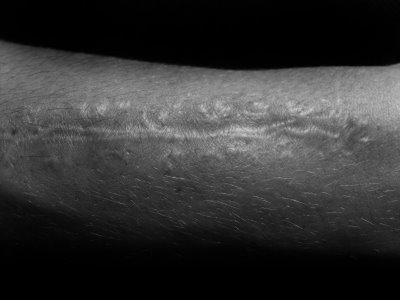
Since 2006, I have been photographing people’s scars and asking them their stories – of the ways they got their scars, what their scars mean to them, and what they mean to other people. Stemming from my personal interest in bodily difference, early experiences as a surgically-saved “miracle baby”, and my studies in narrative therapy, Life Lines has become an internationally collaborative project, with contributions from people of all ages, across many ethnicity and class divides. After writing or having transcribed their narrative, participants are invited to become part of the online segment of the project, which can be found at http://www.onlinelifelines.blogspot.com.
I am proposing an interactive, semi-scholarly presentation at the Arts Interdisciplinaires: Hi-Tech, Lo-Tech, No-Tech? conference as an avenue for opening up an exploration of the many different kinds of technology that go into a project such as this. In past presentations, I have asked the audience to discuss their own experiences of scarring and ‘unsightliness’, examined various ways of visually representing ‘difference’ (e.g. scarring, disability), and critiqued the project through lenses of both the arts and the social sciences. For the RAIQ conference, I would like to focus on the ways that we use different technologies to traverse the same terrain, and the different results those technologies yield within this project.
For example, many of the scars exhibited in Life Lines are the result of surgery. Medical technologies have evaluated this particular zone of the body, found it unsatisfactory and have endeavoured to ‘correct’ it through the means of the scalpel. It is a sensitive area. In having their scars photographed, participants are in some way allowing that zone to be re-assessed; the technology of the camera follows the lines inscribed by the scalpel. It is a repetitive action, a second technological invasion.
And then there is the question of the narrative: according to Anthropology, story is one of the oldest creative technologies. Stories are used to convey information in a compelling way, to give structure to that information so that it is remembered clearly, and to create both a sense of personal identity and a feeling of belonging. In telling their scar stories, participants are once again re-working those particular zones of their bodies.
What do the different levels of technology provide, and what do they lack? What various visual and social representations of the body do they convey? What is the participant’s experience of each technological examination of his/her/their body?
Presentation Abstract:
Svea Vikander will discuss various levels of technology and their methods of assessment and display as they apply to her relational-aesthetic project, Life Lines. Published online at http://www.onlinelifelines.blogspot.com, Life Lines is a space for people to photograph (or to have photographed) their scars; they are then invited to write their story of having acquired the scar, with a description of its importance to them and to other people. Scalpel, camera, narrative – all work toward a representation of a bodily zone that is considered ‘unsightly’ or taboo. What does each technology provide in this process, and what does it deny?
Images Attached:


Project Description:
Life Lines is an interdisciplinary relational-aesthetic project that reaches across the domains of social science, photography, curation, and psychotherapy.
Since 2006, I have been photographing people’s scars and asking them their stories – of the ways they got their scars, what their scars mean to them, and what they mean to other people. Stemming from my personal interest in bodily difference, early experiences as a surgically-saved “miracle baby”, and my studies in narrative therapy, Life Lines has become an internationally collaborative project, with contributions from people of all ages, across many ethnicity and class divides. After writing or having transcribed their narrative, participants are invited to become part of the online segment of the project, which can be found at http://www.onlinelifelines.blogspot.com.
I am proposing an interactive, semi-scholarly presentation at the Arts Interdisciplinaires: Hi-Tech, Lo-Tech, No-Tech? conference as an avenue for opening up an exploration of the many different kinds of technology that go into a project such as this. In past presentations, I have asked the audience to discuss their own experiences of scarring and ‘unsightliness’, examined various ways of visually representing ‘difference’ (e.g. scarring, disability), and critiqued the project through lenses of both the arts and the social sciences. For the RAIQ conference, I would like to focus on the ways that we use different technologies to traverse the same terrain, and the different results those technologies yield within this project.
For example, many of the scars exhibited in Life Lines are the result of surgery. Medical technologies have evaluated this particular zone of the body, found it unsatisfactory and have endeavoured to ‘correct’ it through the means of the scalpel. It is a sensitive area. In having their scars photographed, participants are in some way allowing that zone to be re-assessed; the technology of the camera follows the lines inscribed by the scalpel. It is a repetitive action, a second technological invasion.
And then there is the question of the narrative: according to Anthropology, story is one of the oldest creative technologies. Stories are used to convey information in a compelling way, to give structure to that information so that it is remembered clearly, and to create both a sense of personal identity and a feeling of belonging. In telling their scar stories, participants are once again re-working those particular zones of their bodies.
What do the different levels of technology provide, and what do they lack? What various visual and social representations of the body do they convey? What is the participant’s experience of each technological examination of his/her/their body?
Presentation Abstract:
Svea Vikander will discuss various levels of technology and their methods of assessment and display as they apply to her relational-aesthetic project, Life Lines. Published online at http://www.onlinelifelines.blogspot.com, Life Lines is a space for people to photograph (or to have photographed) their scars; they are then invited to write their story of having acquired the scar, with a description of its importance to them and to other people. Scalpel, camera, narrative – all work toward a representation of a bodily zone that is considered ‘unsightly’ or taboo. What does each technology provide in this process, and what does it deny?
Images Attached:
Tamara

Andrea (Self-Portrait)

Kevin

Shara

Peter (self-portrait)
Subscribe to:
Posts (Atom)